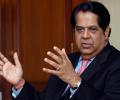
Kamath also said that the new bank, set up by India and four other members of the BRICS grouping, will strive to approve its first loan before end of the current fiscal.

The Union Budget on Wednesday outlined several initiatives to drive India's technology agenda and boost digital infrastructure, including new centres of excellence for artificial intelligence, National Data Governance Policy, and Entity DigiLocker.
With the July 1 deadline to apply for bank licence fast approaching, aspirants are scrambling to meet the Reserve Bank of India's (RBI) eligibility criteria to apply.

Non-performing assets of banks have been on the rise for past several months due to slowdown in the economy.

"The central fiscal situation has improved but several underlying fiscal pressures are not entirely evident in the numbers," Reddy said at an event organised by the National Institute of Public Finance and Policy. In 2008-09, the Centre has budgeted to cut fiscal deficit to 2.5 per cent of GDP from 3.1 per cent in 2007-08.

When Vineet Mittal first got into solar power, sometime around 2009, and was planting solar panels in Gujarat, renewable energy looked like a sector ripe for startups. Renewables were clearly the future of energy, and the big boys - Mukesh Ambani's Reliance, Adani Group, and the Tatas - were focusing much more on coal and petroleum. Little did Mittal know that things were going to change drastically.

Indian cities need $840 bn investment over 15 yrs, says World Bank report.

Bankers pay a small price for their misdeeds, no matter how large the cost to their banks or to the economy at large, says TT Ram Mohan.

For development finance institution to succeed now, the government must stand like a rock behind it and be patient.

Merely bringing down the government stake below 51% may not find any taker for the PSBs. The government must bring down its holding to at least 26%, recommends Tamal Bandyopadhyay.

Could it have been more reformist? Of course, but this is an election year Budget, observes Akash Prakash.

Ajit Doval is now India's all-powerful security boss. This concentration of power disrupts our layered security system. Will it not weaken whatever remains of the power and authority of the home, defence and finance ministers? asks Shekhar Gupta.

Sajjid Chenoy, India economist at JP Morgan is the new part-time member.

Tamal Bandyopadhyay offers some unsolicited advice for a government wh,ich came to power, with brute majority and the nation's pragmatic chief money man.

Reserve Bank of India Governor Raghuram Rajan had said recently that there was "no need" to set up a separate bad bank to deal with stressed assets of public sector lenders.

The Appointments Committee of Cabinet has named Ravneet Kaur, a Punjab cadre IAS officer of 1988 batch, as chairperson of the Competition Commission of India (CCI). Kaur will hold the post for five years or until attaining the age of 65. She is the second woman to serve in an 'economic regulator' role after Madhabi Puri Buch, who was appointed chairperson of the Securities and Exchange Board of India last year and the first woman to head the country's chief national competition regulator.

Fresh buying by domestic institutional investors and better-than-expected June quarter results from some blue-chip companies boosted investor sentiment

It has been a decade since Shyam Srinivasan took over as managing director and chief executive officer at Federal Bank. He wants to ramp up the bank's unsecured lending going ahead even as it homes into the space vacated by competition. Reappointed for a fresh three-year term as the bank's helmsman, he spoke to Hamsini Karthik on the plot ahead.

The Cabinet has cleared a Bill to set up a government-owned development finance institution (DFI) with initial paid-up capital of Rs 20,000 crore so that it can leverage around Rs 3 trillion from the markets in a few years to provide long-term funds to infrastructure projects as well as for development needs of the country. To put it in perspective, Rs 3 trillion constitutes slightly less than 3 per cent of the Rs 111 trillion to be spent on over 7,000 projects in the National Infrastructure Pipeline from 2019-20 to 2024-25. Besides, the government will give Rs 5,000 crore as grant to the institution, Finance Minister Nirmala Sitharaman on Tuesday told the media after the Cabinet meeting.

Among possible new members, former chief economic advisor Arvind Virmani's name is doing the rounds.
The IPO-bound national insurer LIC is not only the largest holder of government debt -- owning 19 per cent of the G-secs -- but also the single largest owner of equities, the largest fund manger as well as holder of household savings, dwarfing even SBI deposits, as per a report. Holding 17 per cent of the over Rs 80.7 lakh crore dated government securities, maturing by 2061, the Reserve Bank is the second largest holder of government debt, while led by public sector banks, commercial banks collectively own around 40 percent. Other insurers cumulatively own only 5 per cent.

Their net NPA as a proportion of net advances were 2.2 per cent, compared with 1.7 per during the same period a year earlier.

A PhD from Chicago-Booth and a top-ranking IIT-IIM alumnus, Krishnamurthy Subramanian is one of the world's leading experts in banking, corporate governance and economic policy

Argentina, Egypt, Ethiopia, Iran, Saudi Arabia and the United Arab Emirates have been invited to join the grouping.
The Finance Ministry has invited private sector bankers.

'There's no pro-China tilt in BRICS.' 'All these countries want to be close to China, but they are all good friends of India also.'

Prime Minister Narendra Modi on Sunday made a fresh push for reforms in global institutions, including the United Nations, asserting that the world's 'new realities' should be reflected in 'new global structure' as it is nature's law that those who don't change with times lose their relevance.

The government has recapitalised public sector banks (PSBs) by infusing over Rs 3.10 lakh crore in the last five fiscals, a majority of which was through issuance of recapitalisation bonds, Parliament was informed on Monday. "Government has infused Rs 3,10,997 crore to recapitalise banks during the last five financial years i.e., from 2016-17 to 2020-21, out of which Rs 34,997 crore were sourced through budgetary allocation and Rs 2,76,000 crore through issuance of recapitalisation bonds to these banks," Minister of State for Finance Bhagwat Karad said in a written reply in the Lok Sabha. He was responding to a host of questions asked by Congress party's Member of Parliament Manish Tewari.

Opportunity for India to take leadership in economic diplomacy.
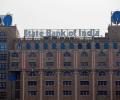
These are untied loans, meaning SBI has freedom to use this money to lend. They also do not come with any conditions attached for lending to specific projects or programmes.

Concerned by GDP slowdown and unrealistic tax targets, the economists urged Finance Minister Nirmala Sitharaman to implement long-term structural steps like land and labour reforms. Warning against any off-Budget financing the economists said the government should prepare a statement of intent for its social, rural and welfare sector expenditure.
Control over PSU banks is what is allowing the government to drive this scheme.

A statement from the finance ministry said, 'it shall be the policy of the Sri Lankan government to suspend normal debt servicing...shall apply to amounts of affected debts outstanding on April 12, 2022'.

Mortgage lender HDFC Ltd on Wednesday announced an increase in its benchmark lending rate by 5 basis points (bps), a move that will make loans dearer for both existing and new borrowers. This is the third hike effected by HDFC in the last one month. "HDFC increases its Retail Prime Lending Rate (RPLR) on housing loans, on which its Adjustable Rate Home Loans (ARHL) are benchmarked, by 5 basis points, with effect from June 1, 2022," the housing finance company said in a statement.

The primary market is set for a bumper Rs 80,000-crore bonanza with 30 companies already filing IPO papers to raise Rs 55,000 crore, while around 10 more are lined up for this month itself, seeking to mop up another Rs 25,000 crore, say investment bankers. The market has been on a non-stop rally, hitting new records almost every week, on the back of an influx of investors -- a vast majority of them first-timers -- coupled with a flood of liquidity. Foreign funds alone had pumped in a record $35 billion into the market in FY21, while the trend has continued this fiscal as well. Domestic institutions led by LIC have also infused trillions of rupees, helping woo retail investors in troves -- the year saw over 20 million new investors coming to the market.

Benchmark indices settled lower on Friday, with the Sensex declining 111 points on the back of a sharp fall in index heavyweight Reliance Industries. The BSE benchmark went lower by 111.01 points or 0.21 per cent to settle at 52,907.93. During the day, it tanked 924.69 points or 1.74 per cent to 52,094.25. The NSE Nifty dipped 28.20 points or 0.18 per cent to close at 15,752.05.

Meanwhile, US President Joe Biden condemned Russia's annexation of Ukrainian territory on Friday.

The Asian Development Bank has approved a US$ 1.5 billion (around Rs 11,185 crore) loan to India for COVID-19 vaccine procurement.

'There is no tried and true recipe for creating Silicon Valleys.' 'Attracting and creating a mass of truly dynamic entrepreneurs is at the core and among the hardest and most necessary ingredients.' 'In the US, close to 60% of the top valued tech companies were started by immigrants who found the start-up climate to be superior to where they came from.' 'India would clearly benefit from attracting back its talented Diaspora, but it also needs to hold onto those entrepreneurs.'

They welcomed the guests before the start of the dinner from the reception dais, with its backdrop showcasing the ruins of the Nalanda University in Bihar besides India's G20 presidency theme -- 'Vasudhaiva Kutumbakam - One Earth, One Family, One Future'.
